
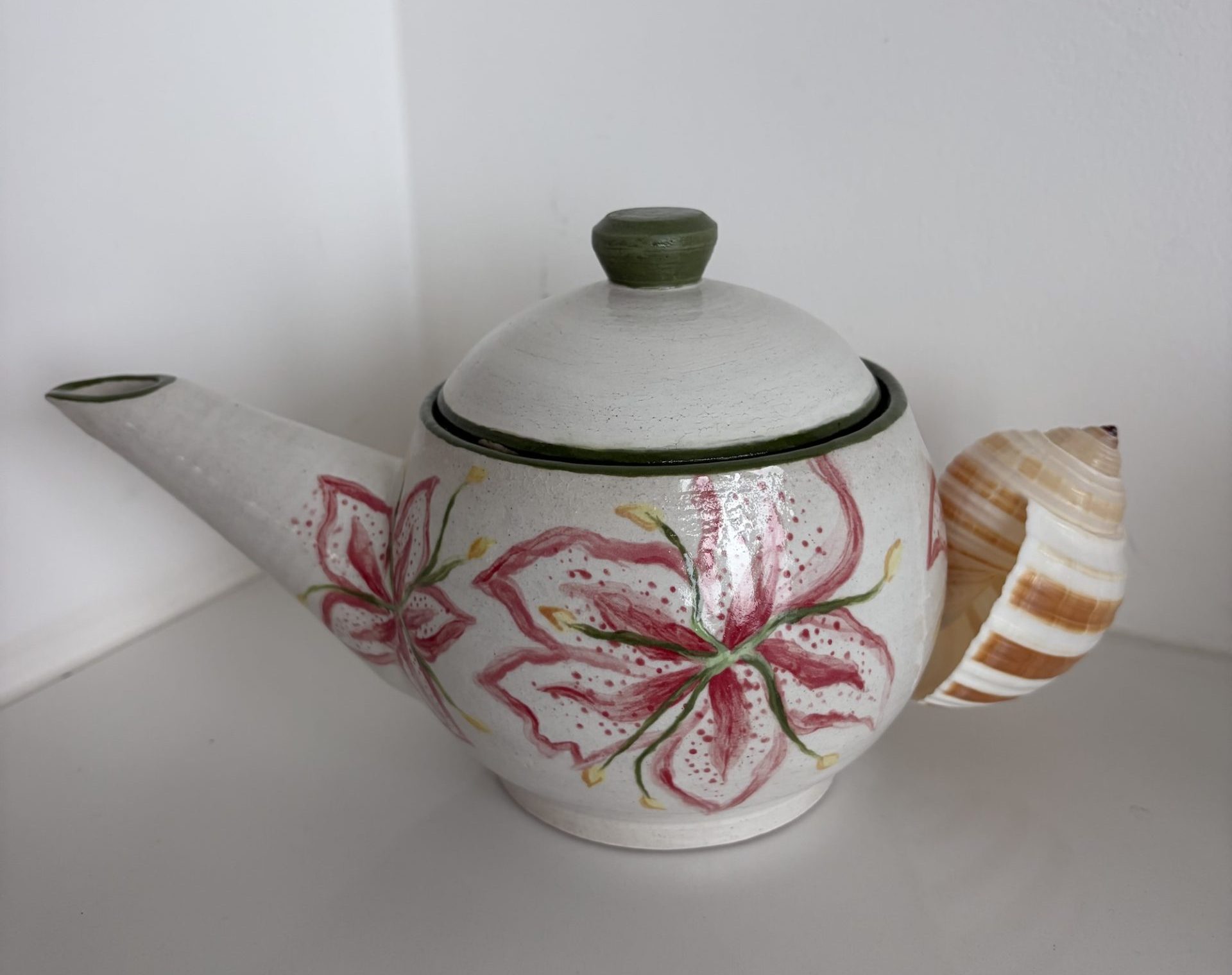
A teapot is the hardest thing I’ve made. Not even close. Four pieces that all have to work together, a dozen ways to fail, and a kiln that doesn’t care about your plans. But here’s what gets me — every failure has a why. And the why is always science.
The Science
- Clay is geology. Flat crystal plates with water between them. They slide, that’s why it’s plastic. Wedging lines them up and pushes out air. Skip it and your trapped air pockets blow up at 600 degrees. Literally.
- The wheel is physics. Centripetal force wants to throw your clay across the room. You fight it. Clay is non-Newtonian — solid when you’re gentle, liquid when you push. Pull a wall too fast, it rips. Too slow, nothing. You just feel it. There’s no other way to explain it.
- Drying is diffusion. Water moves from inside to outside and evaporates. The thin parts — handle, spout — dry first. They shrink. The thick body hasn’t caught up. Crack. Right at the joint. Everything shrinks 5–7% and you’re just hoping all four pieces shrink together.
- Bisque firing is one-way. At 350–600°C, water that’s chemically part of the crystal structure gets ripped out. Dehydroxylation. After that, it’s not clay anymore. It’s ceramic. No going back. At 573°C, silica crystals flip phase and expand 2% all at once. Go through that zone too fast — crack.
- Glazing is where mine went sideways. A glaze is a glass recipe. Silica, alumina, metal oxide. The oxide is the color — iron for amber, cobalt for blue. I tried a wax resist pattern. Paint wax where you want bare clay. Glaze over everything. Fire it, wax burns off, clean lines. That was the plan. My wax was too thin. Glaze bled through. My clean geometric pattern came out smudged. My teacher said “that’s information.” Cool. Thanks.
- Glaze firing is surrender. 1200°C. Everything melts. Glaze fuses to clay. If their expansion rates don’t match — craze, shiver, flake. You can’t watch. You can’t adjust. You close the kiln door and walk away. Mine pooled at the base and nearly welded itself to the shelf. Now I wipe the bottom quarter inch. Every time.
But Whatever — That’s Not Why You Make One
None of that is in my head at the wheel.
The clay is cold. Then it’s not. The wobble stops. You feel it go still through your fingertips and that’s the moment — the lump is centered and the spin is clean and you’re just… in it. Pulling a wall is listening. The clay tells you when to stop. Sometimes I listen. Sometimes I don’t and it collapses and I start over.
A teapot hides nothing. The spout has to pour clean — mine dribbles. The lid has to click into place — you throw it separately, trim it, and pray the shrinkage matches. The surface is the last thing and the first thing people see. I wanted crisp wax lines over blue-green. I got something blurrier. Something I didn’t design. Something I actually like more.
That’s the whole thing with ceramics. You do the science — the recipe, the timing, the temperature — and then you hand it over to a kiln and physics finishes the sentence for you. What comes out is half yours and half not.
My teapot dribbles. The pattern bled. I poured tea from it anyway.
It was good.