
This shouldn’t be political. It’s our planet.
I drew these when I was fifteen, in the Sci|Art program at UCLA the summer between freshman and sophomore year. We were asked to explore how science and art intersect. Most people think that means making science look pretty. It doesn’t. It means using art to ask questions science hasn’t figured out how to ask yet.
A Problem
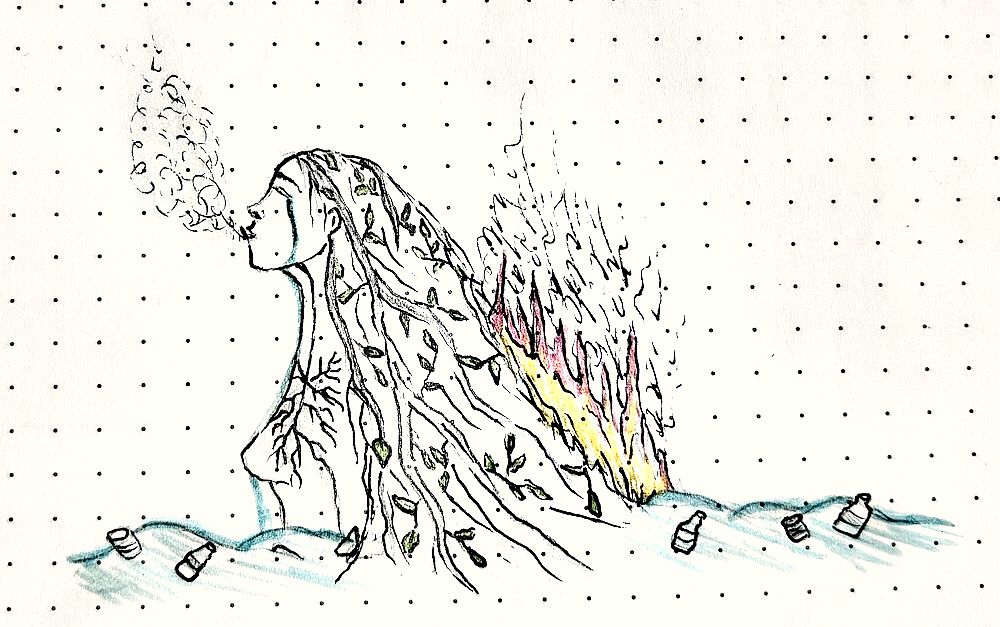
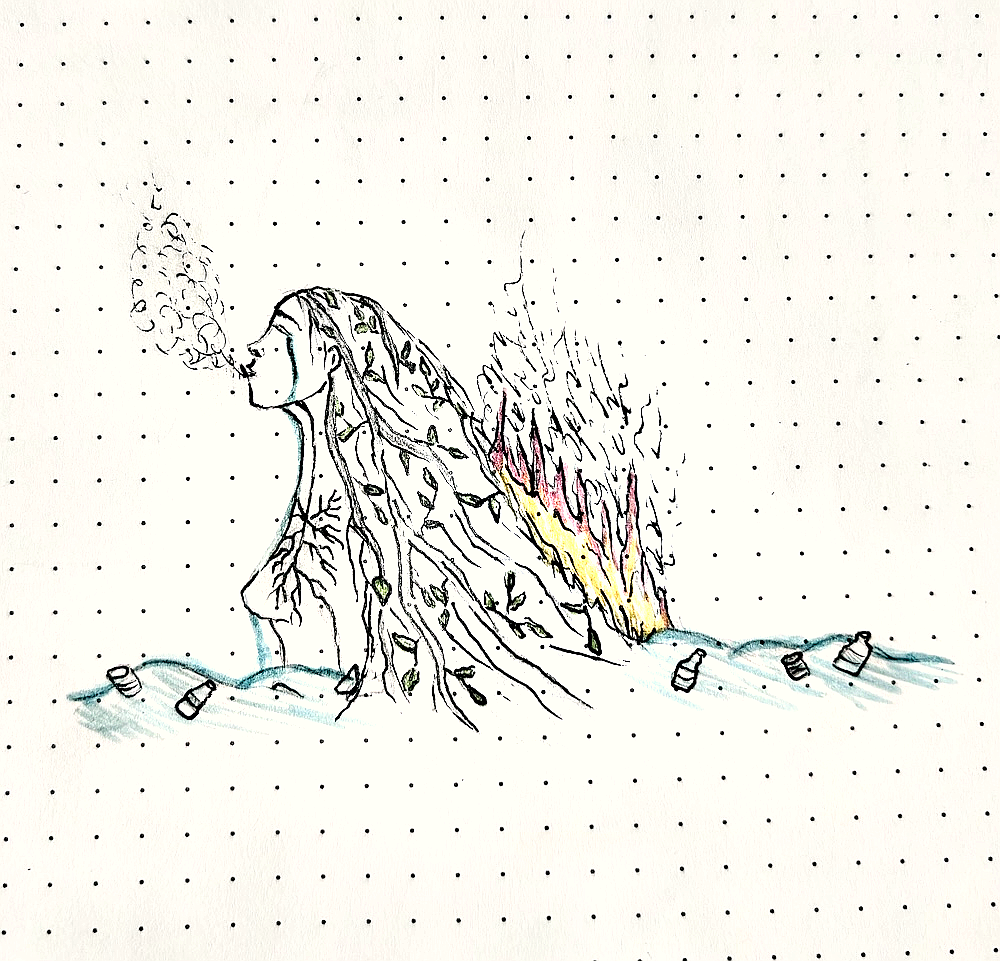
She’s on fire. Her hair is branches and leaves and they’re burning. She’s standing in water full of plastic bottles. She’s breathing out smoke — or maybe the smoke is being forced into her. I wasn’t sure when I drew it. I’m still not sure. That’s the point.
We talk about the environment like it’s a policy debate. It’s not. It’s a body. It breathes, it grows, it gets sick. Right now it’s sick and on fire at the same time, standing in its own waste. I wanted to draw what that actually looks like when you stop using graphs and data and just feel it.
This isn’t subtle and it’s not trying to be.
A Solution
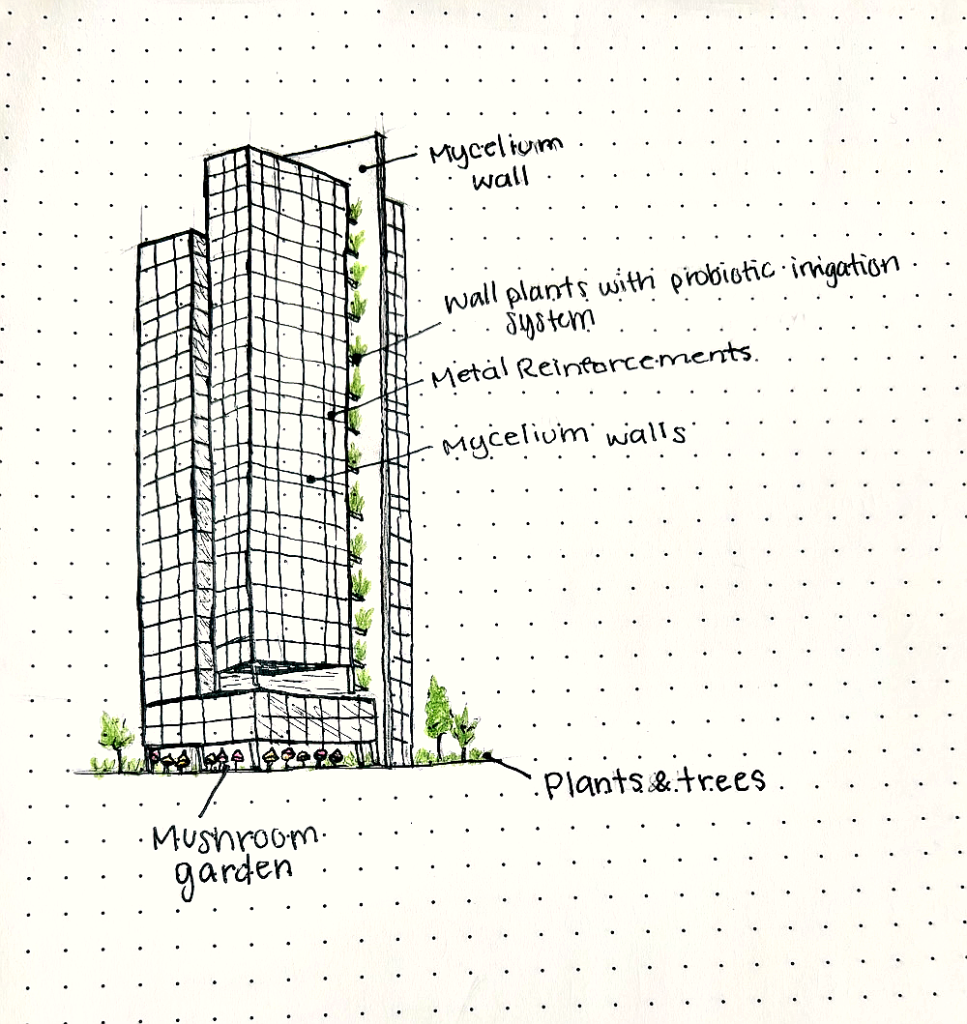
This is a building made of mushrooms. Basically.
Mycelium is the root structure of fungi — a network of tiny threads that grow underground. When you feed mycelium agricultural waste like corn stalks or sawdust, it binds the material together into a solid block as it grows. No heat. No kiln. No carbon emissions. It just… grows into a building material. Then you dry it and it stops. You’ve got a brick that’s lightweight, fireproof, insulating, and fully compostable.
Companies like Ecovative are already making mycelium packaging and insulation. The idea of mycelium walls in an actual high-rise isn’t science fiction — it’s science that hasn’t scaled yet.
My drawing adds a few things:
- Mycelium walls as the primary structural panels, reinforced with metal
- Wall plants with probiotic irrigation — a living skin on the building that filters air and feeds beneficial microbes back into the structure
- A mushroom garden at the base — because if your building is made of fungi, why not grow food there too
- Plants and trees at ground level — the building doesn’t sit on a dead plaza, it sits in an ecosystem
The whole concept is a building that’s alive. Not metaphorically. Literally alive — made of biological material, covered in plants, fed by microbes, producing food. Architecture as organism.
Why This Is a SCI | ART Problem
The science exists. Mycelium bricks are real. Living walls are real. Probiotic systems are real. But nobody’s going to fund a mushroom skyscraper because they read a paper about it. They’re going to fund it because someone showed them what it could look like. Because someone drew it and made them feel something.
That’s what art does that science can’t. Science proves it’s possible. Art makes people care that it’s possible.
I drew a woman on fire in polluted water because data about ocean plastic and wildfire acreage wasn’t making me feel anything anymore. I’d gone numb to the numbers. So I drew what the numbers meant. And then I drew what we could build instead.
I was fifteen. I didn’t know the word mycelium before that summer. I learned it in a lab at UCLA and put it in a drawing the same week. That’s sci|art. Not science made pretty. Science made urgent.
Both pieces were created during the UCLA Sci|Art Studio + Lab Institute, summer 2024.